
Educational Resource Library
Tu B’Shvat Sustainable Resources
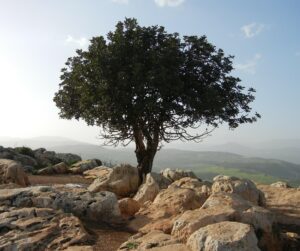
Tu B’Shvat is an ancient celebration of the new year for trees. It has changed and evolved over twenty centuries, and has never been more vital or significant than it is today. We live in an era in which sustainable forestry is more widely practiced than ever before, yet deforestation is a powerful driver of climate change and loss of biodiversity. Trees play important roles in some of the most challenging environmental issues of our time, and the way we use them is important, even in ways you might not expect. For a simple example: saving paper does not just “save trees,” but also prevents burning fossil fuels in transportation and processing.
The resources below, including Hazon’s Haggadot, offer thoughts and ideas to help you celebrate Tu B’Shvat in your home or community. The texts, questions, activities, and suggestions can serve as guides for viewing Tu B’Shvat through fresh eyes and recontextualizing traditions.
Tu B’Shvat Haggadah: Hazon Seder and Sourcebook

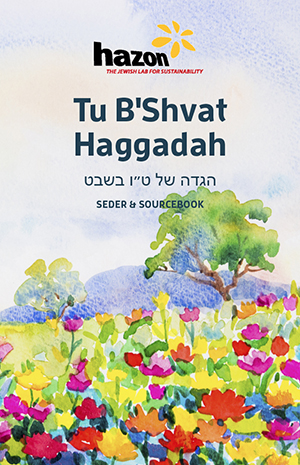
The 2021 Tu B’Shvat haggadah offers thoughts and ideas to help you celebrate the new year for trees in your home or community.
Our new haggadah features the outline for a full seder including blessings over wine and symbolic foods, as well as a variety of thematic activities and discussion topics. The 2021 Haggadah uniquely focuses on the crises we have faced over the last 12 months including racial injustice and the climate crisis.
Download a free copy of the 2021 haggadah
The 2020 Tu B’Shvat haggadah offers thoughts and ideas to help you celebrate the new year for trees in your home or community. This Haggadah uniquely focuses on the science and data around forestation and the role trees play in sustaining a healthy planetary ecosystem while mitigating climate change.
Download a free copy of the 2020 haggadah
 The 2019 Tu B’Shvat haggadah features the blessings on wine and symbolic foods, various thematic activities, as well as four sets of texts focusing on our relationship with food, trees, the land of Israel, and the wider world. Since Martin Luther King Jr. Day falls on Tu B’Shvat this year, the final section adds a social justice component featuring excerpts from Dr. King’s teachings.
Additional Resources
Each year we compile a new Haggadah with wisdom and insights from Jewish tradition. We would like to highlight some of the reflections and excepts from that work here.
- The Four Faces of TuBiShvat by Jeremy Benstein
- General reflections on TuB’Shvat by Nigel Savage and Hazon Programs Staff
- Reflections on Food from previous haggadot
- Reflections on Community from previous haggadot
- Reflections on our connection with the natural world from previous haggadot
- Reflections on the land of Israel from previous haggadot
- Reflections on our relationship with Trees from previous haggadot
- Songs!
- Language for thinking about God
- Source material for Tu B’Shvat from Richard Schwartz, Ph.D.
- Climate Science Facts related to trees
- Tu B’Shvat Family Seder is a great companion to the Tu B’Shvat Haggadah – this downloadable guide is an abbreviated family friendly version of a more traditional seder experience. Complete with games and kid-friendly language.
- Tu B’Shvat Lesson Plans for all ages located on the Hazon Educational Library
- Share a take home workshop from Atiqi Makers, a learning and making workshop for artists and non-artists alike!
- Trees, Earth, and Torah: A Tu B’Shvat Anthology draws upon biblical, rabbinical, medieval, and modern sources – from art, music, recipes, and crafts, as well as fiction, poetry, and essays – about the significance and historical development of Tu B’Shvat.
- The Open Siddur Project shares A Tu Bishvat Prayer for Trees, by Rabbis for Human Rights in Israel, an ecumenical prayer in English, Hebrew, and Arabic. This is a great resource for any tree planting activities.
- This TED Talk on How Trees Talk to Each Other gives a beautiful understanding of the communities that live in our forests.
- This video of a Tu B’Shvat seder celebrates the whole natural world as it also builds community, creates sacred space, and inspires people to live and act with earth in mind – shared by R. Ellen Bernstein.
Music
We’ve compiled a great selection of music for you to make your seder a more multi-faceted experience.
Follow these links to listen to some of the songs that we recommend for Tu’Bsvhat Seders.
Adamah
Sanctuary
Shirat Ha’Asavim
Learn to Live
The Ocean
The Tree Song
Harachaman by Rabbi David Seidenberg
The words of this blessing were written by Rabbi David Seidenberg. Nili Simhai made it into a singable liturgy by setting the words to the “Sosne Nigun” by Jonah Adels, z”l. Harachaman blessings come after the main part of the blessing after the meals, and they ask for special blessings, including blessings related to Shabbat and holidays. Sing it at your Tu B’Shvat seder and at every meal this whole Shmita year! Click here for words and melody.
Recipes
Here are a few of our favorite suggestions for your seder but there are more yummy plant-forward options here.
Baked Apples - Kid friendly
- 4 medium apples, cored
- 4 thin strips lemon rind
- 1/2 cup dried currants or dried cherries
- 1 whole vanilla bean, cut into 4 pieces
- 4 cinnamon sticks
- 1/2 cup lemon juice
Place apples in a baking dish with glass lid
Stuff with lemon rind, currants, vanilla bean, and cinnamon sticks
Drizzle with lemon juice
Scatter remaining currants around apples
Bake covered at 350 degrees Fahrenheit for 60-75 minutes
Originally from: Elana’s Pantry
Stuffed Dates
- 1 cup pistachios, shelled
- 1/4 cup orange juice, freshly squeezed
- 1 tsp orange zest
- 1 pinch sea salt
- 20 large dates – pits removed
In a food processor, pulse pistachios, orange juice, orange zest, and salt
With a sharp knife, make a slit on one side of each date (and remove the pit if necessary)
Place filling in dates
Serve
Originally from: Elana’s Pantry
The Ultimate Babka for Tu B'shvat
Bread:
- 1 Tbsp dry active yeast
- 1/2 tsp sugar
- 1/2 cup lukewarm water
- 3 1/2- 4 1/2 cups all-purpose flour or gluten free flour
- 1/2 cup barley or almond flour
- 1/3 cup sugar
- 1 tsp vanilla
- 1 tsp cinnamon
- 1/2 cup plant-based milk
- 3/4 cup olive oil
- 2 eggs or egg replacers
Filling:
- 1 cup dried figs, cut in half
- 1 cup pitted dates
- 1 cup water
- 1/2 cup red wine or grape juice
- 1 Tbsp pomegranate molasses
- 1/4 tsp cinnamon
Topping:
- date honey
- slivered almonds
Place yeast and sugar in a small bowl. Add lukewarm water and set aside until foamy, around 5-10 mins.
In a stand mixer fitted with dough hook or a large bowl, mix together flours, sugar vanilla and cinnamon. Start with 3 1/2 cups of flour, add more later if dough seems sticky. Add milk and olive oil.
Add eggs one at a time.
When dough begins to come together, after about 3-5 mins, turn out onto a floured surface and knead vigorously for 5-10 mins. Or if using a stand mixer, switch to high and mix another 4-5 mins. Dough should be shiny, elastic and very soft when it is done. If dough is sticking too much, add more flour 1/4 cup at a time until dough is no longer sticking.
Place dough in a greased bowl with damp towel on top – allow to rise for 1-2 hours.
Combine all filling ingredients in a saucepan over medium heat. Bring to a boil, then reduce for 10 mins, until liquid has reduced to slightly more than half. Allow to cool slightly. Place in food processor and pulse.
Preheat oven to 350 degrees Farenheit
Cut dough into two parts. Roll out each section of dough until it is a rectangular-like shape. Spread with filling. Working from the shorter side, roll up dough using quick fingers, like you would in order to make a cinnamon roll.
Once the dough is a long log, cut it straight down the middle so the filling is exposed. Secure the ends on one side, and twist both the pieces. Pinch and secure at the other end.
Place in a greased loaf pan. Allow to rise another 10-2- mins. Sprinkle top with slivered almonds if desired (this is optional)
Bake 30-35 mins.
Top with date honey if desired.
Originally from myjewishlearning’s The Nosher.
Sustainability Tips
Host a sustainable Tu B’Shvat Seder. Joining family and friends, host a seder using the Hazon Tu B’Shvat haggadah and sourcebook!
Go green in your community. The Hazon Seal of Sustainability is a roadmap for Jewish institutions to become more sustainable by enabling improvements related to food, facilities, and healthy ecosystems.
Advocate. As we come off the warmest year in recent human history, we’re happy to be working directly with 350.org. We want to encourage Jewish people, as Jewish people, to join and get involved in their local 350.org chapters to take action for the environment on the state and local level. Check out Jewish Action Climate Network for more information.
Think about Fair Trade. Host a Tu B’Shvat seder focusing on the environmental benefits of fair trade (Download the Long Island Hazon CSA “How-to” guide for a Fair Trade seder). Use fair trade certified dried dates, almonds, and walnuts at your Tu B’Shvat seder
Eat Local. If you live in an area with a variety of seasonal, winter offerings, use this to your advantage by eating local. In the south, citrus fruits are in season and can provide a great addition to the Tu B’Shvat celebration: try citrus curls in your drinks, lemon curd for dessert, or roast chicken with oranges and lemons inside.
Reuse and Recycle. In modern times, Tu B’Shvat has been transformed into a holiday embracing nature, which allows us to focus our intentions on many environmental areas. In addition to supporting sustainable eating, try to cut down waste by using reusable, or compostable, dishes and recycle when possible. For resources and suggestions, visit the Hazon Food Guide.
Compost! Collect leftover fruit and vegetable scraps from your Tu B’Shvat seder and add them to your compost pile (or bring them to a composting facility). You’re kicking off the new year of the trees by contributing to soil fertility and the cycles of life!
Go out and plant! Tu B’Shvat is a great time to start a garden, with sufficient time to start growing so that you can put the garden to use during Pesach! So, take the time during this holiday to plant with the family and enjoy homegrown fruits and veggies. If you don’t have a place to garden, there are plenty of ways to grow veggies and plants indoors.
Dig in
Tu B’Shvat (Hebrew: ט״וּ בִּשְׁבָט, Tu Bee-Shvat) is a Jewish holiday in the Hebrew month of Shvat, usually sometime in late January or early February, that marks the “New Year of the Trees” (Hebrew:ראש השנה לאילנות, Rosh HaShanah La’Ilanot). Tu B’Shvat is one of four “New Years” mentioned in the Mishnah. Customs include planting trees and eating dried fruits and nuts, especially figs, dates, raisins, carob, and almonds. In Israel, the flowering of the almond tree, which grows wild around the country, coincides with Tu B’Shvat.
In the Middle Ages, Tu B’Shvat was celebrated with a feast of fruits in keeping with the Mishnaic description of the holiday as a “New Year.” In the 1600s, the kabbalist Rabbi Yitzchak Luria of Safed and his disciples instituted a Tu B’Shvat seder in which the fruits and trees of the Land of Israel were given symbolic meaning. The main idea was that eating ten specific fruits and drinking four cups of wine in a specific order while reciting the appropriate blessings would bring human beings, and the world, closer to spiritual perfection.
In Israel, the kabbalistic Tu B’Shvat seder has been revived, and is now celebrated by many Jews, religious and secular. Special haggadot have been written for this purpose.
In modern times, many Jewish organizations, including Hazon, have connected Tu B’Shvat to the issues on sustainability and environmental awareness. This year, we would like to have Tu B’Shvat Shabbat tables across America discussing sustainability and environmental issues. Hazon can help you plan a menu and prepare text for discussion.
Beyond the Four Worlds
Read Nigel Savage’s piece, “Beyond ‘The Four Worlds’: Creating Meaning in Your Tu B’Shvat Seder”